
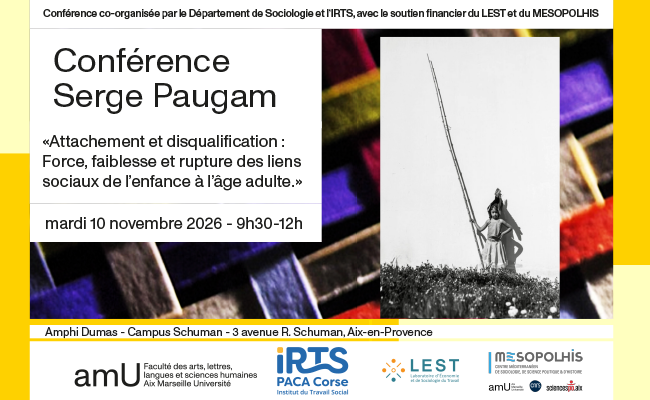
The Department of Sociology and the RegionalInstitute of Social Work (IRTS PACA Corse) invite us to attend a lecture by Serge Paugam,“Attachment and Social Disqualification: Strength, Weakness, and the Breakdown of Social Bonds from Childhood to Adulthood,” in which he will revisit these two concepts he has developed in recent years: social attachment and social disqualification.
“To mark the publication of the book*In Search of Liberating Bonds*(D’une rive à l’autre, 2026), co-authored by Serge Paugam, Isabelle Parizot, and the children of the Pivot culturel de Noisy-le-Grand, as well as the reissue of*Social Attachment: Forms and Foundations of Human Solidarity(Points, 2025), Serge Paugam will deliver a lecture devoted to two concepts he has developed in recent years: social attachment and social disqualification...”
These two concepts appear to be opposites. The first corresponds to the learning and interweaving of social bonds from childhood through adulthood and aims to highlight what holds individuals in modern societies together, while the second, on the contrary, allows us to analyze the process that leads individuals and groups to experience the cumulative weakening and breakdown of social bonds, ultimately resulting in social rejection.
Yet these two sociological concepts converge on two points:
- both are based on a precise definition of the social bonds that connect human beings to one another and to society (which they form together precisely through this connection), the first concept emphasizing how these bonds are formed and can be maintained, while the second highlights how they can also become fragile and break down over the course of a lifetime;
- these two concepts also share the common characteristic of describing a long-term process that links childhood to the various stages of adult life; neither is defined as a fixed status, but, on the contrary, by phases of human existence, the lived experience of which varies greatly depending on individuals and social groups.
In other words, discussing attachment and the “ ” disqualification from childhood to adulthood—by linking these two concepts—amounts to defining, from a sociological perspective, both what binds us and what unbinds us, and to viewing them not as two radically opposed entities, but rather two processes at work simultaneously in modern societies, calling on policies and human actions to tirelessly forge bonds that liberate, that is, bonds that ensure for everyone both protection against life’s uncertainties and the recognition that gives meaning to life and nurtures human dignity.
This conference will also aim to demonstrate that today we cannot be content with studying social bonds solely through surveys of adults, but must also strive to gather children’s lived experiences and thus listen to what they have to teach us.
____
Serge Paugam is a research director at the CNRS, a director of studies at the École des Hautes Études en Sciences Sociales (EHESS), and a professor of sociology at the University of São Paulo (USP). He is a tenured researcher at the International Research Laboratory 2034 “Mondes en transition” (CNRS-USP), located on the University of São Paulo campus, and an associate researcher at the Maurice Halbwachs Center (CMH) (UMR 8097, CNRS - EHESS - ENS - INRAE).
This event is co-organized by the Department of Sociology at Aix-Marseille University and the Regional Institute of Social Work (IRTS PACA Corse), with financial support from the LEST and MESOPOLHIS research laboratories.
Dumas Lecture Hall, Schuman Campus
3 Avenue R. Schuman,
Aix-en-Provence
